Private-Label Bathroom Packaging: An Artwork and Packing Approval Checklist

Private-label packaging has two jobs: protect the product through the agreed distribution route and help the next person identify, install and support it. A logo on a box does not complete either job. Before production, approve a packing specification and artwork proof tied to the exact model and order.
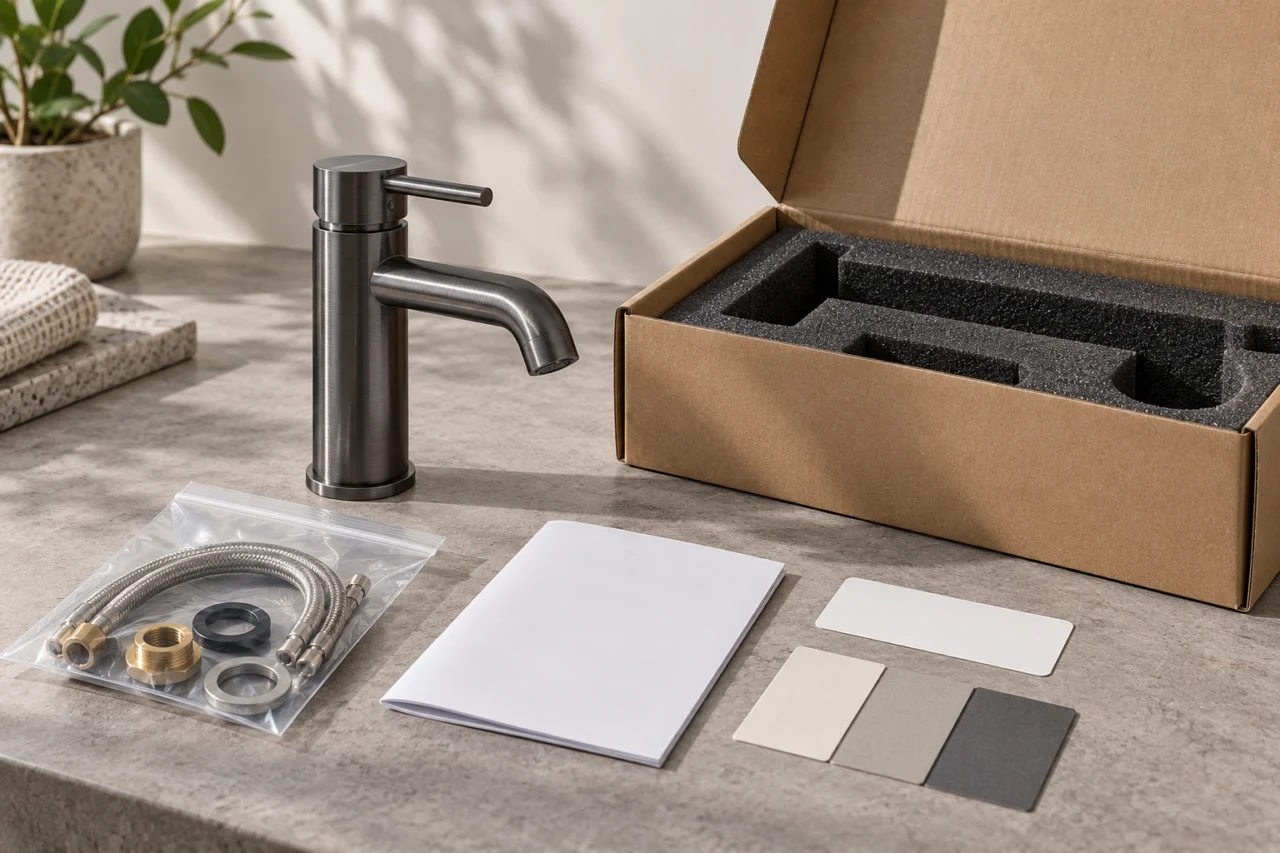
The featured image is an AI-generated editorial packaging illustration. It is not a photograph of an Aqvia factory, an actual supplied package or an approved product configuration.
Start with the sales and distribution route
Describe where the product will go after leaving the supplier. A palletised wholesale shipment, individual parcel delivery and a hotel installation programme can have different handling and labelling needs. State whether units will be repacked locally or delivered to the final user in the original carton.
Record the intended language, destination, sales channel and who approves any market-specific labelling requirements. Do not add certification marks or regulatory claims to artwork unless the relevant permission and supporting documentation have been confirmed.
Define the complete pack contents
| Specification section | Approval questions |
|---|---|
| Main product | Which model, revision and finish is this package for? |
| Accessories and hardware | Which hoses, seals, adapters, fixings or tools are included? |
| Protection | How are visible surfaces and moving components protected? |
| Documents | Which installation, care and support instructions are required? |
| Identification | Where are model, finish, batch and customer SKU recorded? |
| Outer carton | What are the verified unit count, dimensions and gross weight? |
Use a packing photograph and a numbered component list. Every loose part should have an agreed location. Small hardware should not move freely against a finished surface. Confirm that the package can be opened without damaging the product or losing essential fittings.
Make artwork a controlled document
Create one artwork approval sheet with a file name, revision number, date and approver. Check the product name, model code, finish description, quantity, language and contact information. Test any barcode or QR code from an actual-size printed proof and verify that it resolves to the intended product or support page.
Separate editable artwork from the final approved print file. Identify the panels that change between models so a future order does not inherit the wrong photograph, specification or SKU. Ask the supplier how obsolete labels and cartons will be prevented from entering the new packing run.
Choose packaging validation for the actual journey
A thick carton alone does not demonstrate shipping suitability. ISTA’s package-design guidance starts with understanding the distribution environment. Agree an appropriate validation approach with the packaging supplier or test laboratory, based on the packed product and intended handling route.
Keep the tested packaging configuration and results with the approval record. Avoid presenting a generic transport test as a guarantee against every shipping event. If the product, protective insert, carton or packing process changes, review whether the validation still applies; ISTA’s retesting guidance explains why changes can trigger another assessment.
Approve a packed sample before release
Review a complete packed sample using the intended printed materials. Check model identification, component count, opening sequence and the readability of instructions. Photograph the final arrangement and record any remaining corrections. Make the written release refer to that packaging revision, not simply “same as last time.”
For a mixed-model shipment, request a carton schedule that links each outer label to the correct contents. This helps warehouse staff and hotel contractors identify products without opening every carton.
Common buyer questions
What information should I send for a packaging quotation?
Send the selected models, quantities, destination, distribution route, branding files, language needs and required pack contents. Ask the supplier to confirm available customisation and costs for that scope.
Can packaging be reused for a similar faucet?
Only after checking the new product’s geometry, weight and included components. Similar appearance does not prove that an insert or tested package remains suitable.
Use the sample inspection checklist alongside this packaging record so product and pack approval refer to the same model revision.
Prepared by Aqvia Bath for wholesale and project buyers. Catalogue examples are illustrative. Confirm current model specifications, compatibility, included parts and commercial terms in the written quotation. This guide does not certify a product or replace professional installation advice.
Continue your sourcing research
Shower Set Sample Inspection: A Practical Checklist Before a Bulk Order
Build a repeatable shower-set sample review covering parts, installation fit, outlet operation, finish and the evidence to approve before a bulk purchase.
Read the guide
Matching Gunmetal Bathroom Finishes Across Showers, Faucets and Accessories
Create a finish approval record for coordinated bathroom collections, with physical samples, lighting checks, care instructions and model-specific test evidence.
Read the guideBasin Faucet Height and Spout Reach: What Buyers Should Measure Before Ordering
Use a basin-and-faucet measurement worksheet to check outlet reach, rim clearance, mounting space and handle movement before approving samples or bulk orders.
Read the guide